
- Introduction
Waste management stands at the forefront of Uganda’s environmental and public health challenges, governed by a complex legal and regulatory framework aimed at fostering sustainable practices and mitigating environmental impacts. As Uganda undergoes rapid urbanization and industrialization, the management of waste, both solid and hazardous, presents significant challenges and opportunities. The recent catastrophe at the Kiteezi landfill, though regrettable, is a timely case in point.
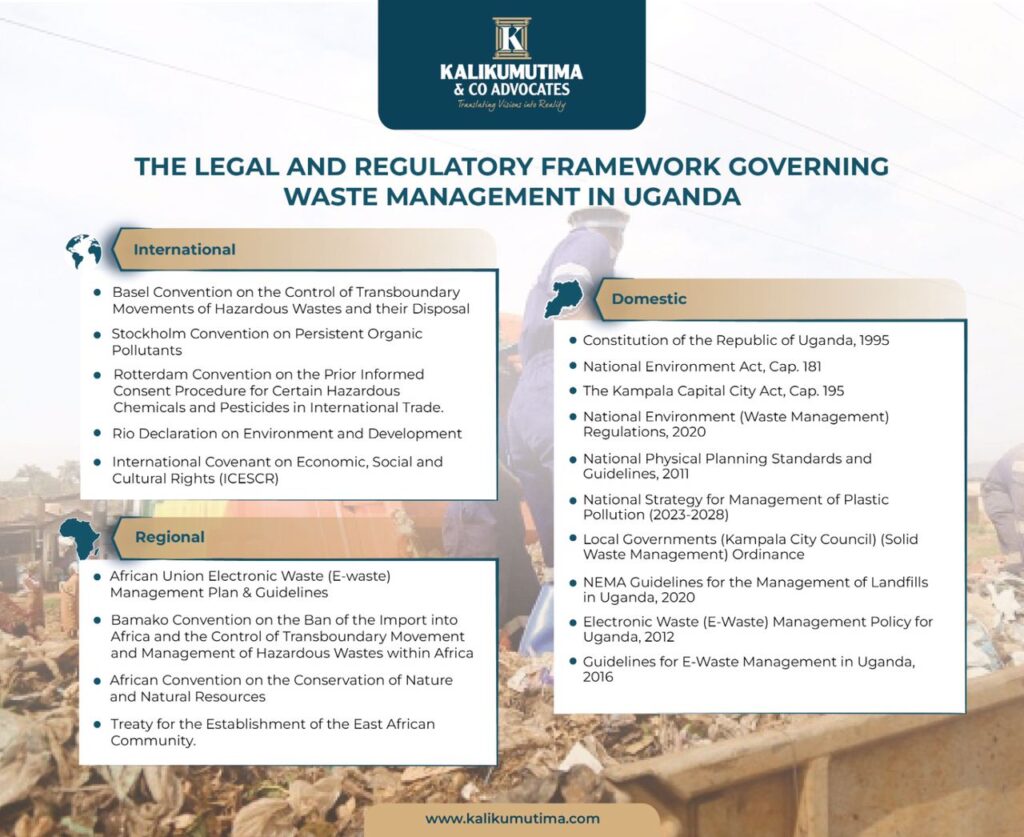
Uganda’s legal landscape, shaped by international and regional commitments, national laws and policies, and local governance structures, plays a pivotal role in guiding waste management practices across various sectors. This article explores the multifaceted legal and regulatory framework governing waste management in Uganda, highlighting key policies, institutional responsibilities and enforcement mechanisms for achieving effective waste management solutions.
- International
- Basel Convention on the Control of Trans-boundary Movements of Hazardous Wastes and their Disposal
The Basel Convention on the Control of Trans-boundary Movements of Hazardous Wastes and their Disposal is a crucial international treaty that addresses the complex and pressing issue of hazardous waste management on a global scale. Adopted in 1989 and entering into force in 1992, the Convention aims to protect human health and the environment from the dangers posed by the generation, trans-boundary movement, and disposal of hazardous wastes. It establishes a legal framework that regulates the export and import of hazardous wastes, requiring prior informed consent from receiving countries and promoting environmentally sound management practices. The Convention also places a strong emphasis on reducing hazardous waste generation at its source and encourages the treatment and disposal of such wastes as close as possible to their source of origin. By fostering international cooperation, the Basel Convention seeks to prevent the dumping of hazardous waste in developing countries and ensure that waste is managed in a way that minimizes risks to people and the planet.
- Stockholm Convention on Persistent Organic Pollutants
The Stockholm Convention on Persistent Organic Pollutants (POPs) is a global environmental treaty aimed at eliminating or reducing the release of hazardous chemicals known for their long-lasting and harmful effects on human health and the environment. Adopted in 2001 and entering into force in 2004, the Convention specifically targets a group of chemicals, including pesticides, industrial chemicals, and by-products, which persist in the environment, bio-accumulate through the food chain, and pose significant risks to human health and ecosystems. The treaty obligates participating countries to take measures to eliminate or restrict the production, use, and disposal of POPs, as well as to manage and safely dispose of stockpiles and contaminated sites. Additionally, the Stockholm Convention promotes the development and use of safer alternatives, supports capacity-building and technical assistance in developing countries, and fosters international cooperation in research and information exchange to combat the global spread of these dangerous pollutants. Through these efforts, the Convention seeks to protect current and future generations from the detrimental impacts of POPs.
- Rotterdam Convention on the Prior Informed Consent Procedure for Certain Hazardous Chemicals and Pesticides in International Trade.
The Rotterdam Convention on the Prior Informed Consent (PIC) Procedure for Certain Hazardous Chemicals and Pesticides in International Trade is an international treaty designed to promote shared responsibilities and cooperative efforts among countries in managing the trade of hazardous chemicals. Adopted in 1998 and entering into force in 2004, the Convention empowers countries to make informed decisions about the import of hazardous substances that may pose significant risks to human health and the environment. The PIC procedure requires exporting countries to notify and obtain explicit consent from importing countries before shipping chemicals listed under the Convention. This process ensures that importing nations are aware of the potential dangers and can take appropriate measures to protect their populations and ecosystems. The Convention covers a wide range of hazardous pesticides and industrial chemicals that have been banned or severely restricted in many countries due to their harmful effects. By facilitating information exchange, technical assistance, and cooperation, the Rotterdam Convention aims to prevent the unwanted importation of dangerous chemicals, thereby contributing to global efforts to manage chemical risks and promote safe and sustainable trade practices.
- Rio Declaration on Environment and Development
The Rio Declaration on Environment and Development, adopted at the United Nations Conference on Environment and Development (UNCED) in Rio de Janeiro in 1992, is a foundational document that outlines 27 key principles guiding global efforts toward sustainable development. The Declaration emphasizes the interdependence of environmental protection and economic development, advocating for an integrated approach to address the challenges posed by environmental degradation while promoting human well-being. It highlights the importance of the precautionary principle, which calls for preventive action in the face of environmental threats even when scientific certainty is lacking, and the polluter-pays principle, which asserts that those responsible for pollution should bear the costs of managing it. The Declaration also stresses the need for public participation in environmental decision-making, equitable development that considers the needs of current and future generations, and the special attention required for the vulnerabilities of developing countries. As a cornerstone of international environmental policy, the Rio Declaration has shaped global discourse and influenced subsequent treaties and agreements aimed at achieving sustainable development.
- International Covenant on Economic, Social and Cultural Rights (ICESCR)
The International Covenant on Economic, Social and Cultural Rights (ICESCR) is a cornerstone human rights treaty adopted by the United Nations General Assembly in 1966 and entering into force in 1976. It commits its 170 state parties to respect, protect, and fulfill a wide range of economic, social, and cultural rights essential for human dignity and well-being. These rights include the right to work in just and favorable conditions, the right to social security, the right to an adequate standard of living—including adequate food, clothing, and housing—the right to the highest attainable standard of physical and mental health, and the right to education and participation in cultural life. The ICESCR recognizes that the full realization of these rights may be achieved progressively, acknowledging that countries have different levels of resources, but it obligates states to take steps toward these goals to the maximum of their available resources. The Covenant also emphasizes non-discrimination and equality, ensuring that these rights are guaranteed to all individuals without distinction. As a key component of the international human rights framework, the ICESCR underscores the importance of economic, social, and cultural rights as integral to human dignity and global justice. In Art. 12, the ICESCR recognizes the right of everyone to the highest attainable standard of physical and mental health.
- Regional
- African Union Electronic Waste (E-waste) Management Plan & Guidelines
The African Union (AU) Electronic Waste (E-waste) Management Plan & Guidelines represent a significant regional initiative aimed at addressing the growing challenge of electronic waste across the African continent. As Africa experiences rapid technological adoption and increasing consumption of electronic devices, the resultant e-waste presents serious environmental and public health risks due to the hazardous substances contained in discarded electronics. The AU’s E-waste Management Plan provides a comprehensive framework for member states to develop and implement effective e-waste policies, promoting environmentally sound management practices from collection to disposal. The guidelines emphasize the importance of establishing legal and regulatory frameworks, building institutional capacities, and fostering public-private partnerships to ensure the responsible recycling and disposal of e-waste. Additionally, the plan encourages the adoption of the circular economy model, which seeks to minimize waste generation through the repair, reuse, and recycling of electronic products. By promoting regional cooperation and harmonization of e-waste management strategies, the AU aims to protect human health and the environment while also creating economic opportunities through the sustainable handling of electronic waste.
- Bamako Convention on the Ban of the Import into Africa and the Control of Transboundary Movement and Management of Hazardous Wastes within Africa
The Bamako Convention on the Ban of the Import into Africa and the Control of Transboundary Movement and Management of Hazardous Wastes within Africa is a landmark treaty adopted by African nations in 1991 and entering into force in 1998. This Convention was developed as a direct response to the increasing threat posed by the illegal dumping of hazardous wastes in Africa, often by foreign entities seeking to evade stricter regulations in their home countries. The Bamako Convention, often seen as a complement to the Basel Convention, goes further by imposing a total ban on the importation of hazardous wastes into Africa and strictly regulating their movement within the continent. It mandates African nations to take legal and institutional measures to prevent the import and illegal traffic of hazardous wastes, while also promoting safer waste management practices domestically. The Convention also requires member states to monitor and report on hazardous waste activities and to cooperate in enforcing its provisions. By prioritizing the protection of human health and the environment, the Bamako Convention underscores Africa’s collective commitment to safeguarding the continent from the dangers of hazardous waste, while also asserting its right to self-determination in environmental matters.
- African Convention on the Conservation of Nature and Natural Resources
The African Convention on the Conservation of Nature and Natural Resources, also known as the Algiers Convention, is a significant regional treaty aimed at promoting the sustainable management and conservation of Africa’s rich biodiversity and natural resources. Originally adopted in 1968 and revised in 2003, the Convention reflects Africa’s commitment to balancing environmental protection with socio-economic development. It covers a broad range of natural resources, including wildlife, soil, water, and forests, emphasizing the need for their sustainable use to benefit present and future generations. The Convention encourages member states to implement policies and legislation that safeguard ecosystems, protect endangered species, and manage natural resources in a way that prevents degradation and promotes regeneration. It also highlights the importance of integrating conservation into national and regional development planning, recognizing that healthy ecosystems are crucial for human well-being, food security, and economic prosperity. By fostering cooperation among African nations and promoting the adoption of best practices in conservation, the African Convention on the Conservation of Nature and Natural Resources plays a vital role in preserving the continent’s environmental heritage while supporting sustainable development.
- Treaty for the Establishment of the East African Community
The Treaty for the Establishment of the East African Community (EAC) is a foundational agreement that lays the groundwork for regional integration among the East African countries; Kenya, Uganda, Tanzania, Rwanda, Burundi, South Sudan and the Democratic Republic of Congo (DRC). Signed in 1999 and entering into force in 2000, the Treaty aims to foster economic, social, and political cooperation among member states, with the ultimate goal of creating a prosperous, competitive, and stable region. The EAC Treaty provides a comprehensive framework for the establishment of a customs union, a common market, a monetary union, and eventually, a political federation. It emphasizes the free movement of goods, services, capital, and people across member states, aiming to boost trade, investment, and economic growth within the region. The Treaty also promotes cooperation in various sectors, including infrastructure development, environmental protection and waste management, health, education, and science and technology. Through these efforts, the EAC seeks to enhance the quality of life for its citizens, strengthen regional stability, and position East Africa as a significant player in the global economy. The Treaty reflects the shared vision of the member states to build a more integrated and unified East Africa, fostering peace, security, and sustainable development across the region.
- Domestic
- Constitution of the Republic of Uganda, 1995
The Constitution of the Republic of Uganda, 1995, serves as the supreme law of the land, laying the foundation for governance, the protection of human rights, and the rule of law in Uganda. Promulgated on October 8, 1995, the Constitution was a product of extensive consultation and debate, reflecting the aspirations of Ugandans for peace, stability, and democratic governance following years of political turmoil. It establishes Uganda as a sovereign state with a republican system of government, characterized by a separation of powers among the executive, legislature, and judiciary. The Constitution enshrines fundamental rights and freedoms, including civil, political, economic, social, and cultural rights, and provides mechanisms for their protection and enforcement. It also outlines the structure of government, the functions of various state organs, and the principles of good governance, accountability, and transparency. Notably, the Constitution includes provisions for the decentralization of power, promoting local governance and citizen participation in decision-making processes. Over the years, the Constitution has undergone amendments to address emerging issues and challenges, but it remains a crucial instrument in guiding Uganda’s development and safeguarding the rights and dignity of its citizens. Notably, Art. 39 recognizes the right of every person in Uganda to a clean and healthy environment.
- National Environment Act, Cap. 181
The National Environment Act, Cap. 181, is a key piece of legislation designed to provide a comprehensive legal framework for the protection, conservation, and sustainable management of the environment in Uganda. Enacted in 1995, the Act establishes the National Environment Management Authority (NEMA) as the central institution responsible for overseeing environmental affairs, implementing policies, and ensuring compliance with environmental standards. The Act outlines a range of environmental management practices, including the assessment and regulation of environmental impacts, the control of pollution, and the conservation of natural resources. It also emphasizes the importance of public participation in environmental decision-making and the integration of environmental considerations into national and local development plans. By setting out principles and procedures for managing and protecting Uganda’s natural heritage, the National Environment Act aims to balance economic development with environmental sustainability, addressing challenges such as deforestation, land degradation, and pollution. Through its provisions, the Act seeks to promote a healthier environment and improve the quality of life for current and future generations. Notably, Part VII thereof encapsulates the subject of waste management.
- The Kampala Capital City Act, Cap. 195
The Kampala Capital City Act, Cap. 195, is a crucial legislative framework governing the administration and management of Kampala, the capital city of Uganda. Enacted in 2010, the Act establishes the legal and institutional structures necessary for the effective governance of Kampala, providing a foundation for urban planning, development, and service delivery in the city. It defines the roles and responsibilities of key institutions, including the Kampala Capital City Authority (KCCA), which is tasked with overseeing the city’s administration, infrastructure, and public services. The Act outlines the functions of KCCA’s leadership, including the Lord Mayor and the Kampala City Council, and emphasizes the importance of transparency, accountability, and public participation in urban management. It also addresses various aspects of urban development, such as land use, environmental management, and economic development, aiming to promote sustainable growth and improve the quality of life for Kampala’s residents. By providing a structured approach to city governance, the Kampala Capital City Act seeks to ensure that the capital can effectively meet the needs of its growing population while enhancing its role as a vibrant and functional urban center.
- National Environment (Waste Management) Regulations, 2020
The National Environment (Waste Management) Regulations, 2020, represent a significant advancement in the Uganda’s approach to managing waste and mitigating its environmental impacts. These regulations, which build upon the framework established by the National Environment Act, Cap. 181 provide detailed guidelines and procedures for the management of various types of waste, including solid, liquid, and hazardous waste. They emphasize the principles of waste minimization, segregation, recycling, and safe disposal, aiming to reduce the environmental and public health risks associated with waste. The regulations outline the responsibilities of waste generators, collectors, transporters, and disposal facilities, and establish standards for waste management practices to ensure they are environmentally sound. Additionally, they incorporate mechanisms for monitoring and enforcement, including penalties for non-compliance, to ensure effective implementation. By promoting a more systematic and regulated approach to waste management, the 2020 regulations seek to address challenges such as waste accumulation, pollution, and health hazards, while supporting Uganda’s broader goals of sustainable development and environmental protection.
- National Physical Planning Standards and Guidelines, 2011
The National Physical Planning Standards and Guidelines, 2011, are a comprehensive set of regulations designed to guide urban and rural planning processes across the country. These standards and guidelines aim to ensure that physical development is undertaken in a systematic, efficient, and sustainable manner, addressing the needs of both current and future populations. They provide a framework for land use planning, zoning, and infrastructure development, emphasizing principles such as optimal land utilization, environmental protection, and community well-being. The guidelines cover various aspects of physical planning, including the preparation of development plans, the design of public spaces, and the integration of transportation and utility services. By setting clear standards for planning practices and promoting consistency across different regions, the 2011 guidelines seek to enhance the quality of urban and rural environments, support sustainable development, and improve the overall livability and functionality of communities throughout Uganda.
- National Strategy for Management of Plastic Pollution (2023-2028)
The National Strategy for Management of Plastic Pollution (2023-2028) represents a forward-looking and comprehensive approach by Uganda to address the escalating issue of plastic pollution. Launched in 2023, this strategic framework outlines a series of targeted actions and policies aimed at reducing plastic waste, promoting recycling, and encouraging the use of sustainable alternatives. The strategy focuses on key areas such as waste reduction, improved waste management infrastructure, public education and awareness, and the promotion of innovative solutions to minimize plastic use. It emphasizes the importance of stakeholder collaboration, including government agencies, businesses, and civil society, in implementing effective measures and monitoring progress. By setting ambitious yet achievable goals for the next five years, the strategy seeks to mitigate the environmental and health impacts of plastic pollution, enhance the sustainability of waste management practices, and foster a culture of environmental responsibility across Uganda.
- Local Governments (Kampala City Council) (Solid Waste Management) Ordinance
The Local Governments (Kampala City Council) (Solid Waste Management) Ordinance is a pivotal piece of legislation tailored to address the specific challenges of solid waste management within Kampala. Enacted to provide a structured and efficient framework for managing the city’s waste, the Ordinance establishes clear responsibilities for the Kampala Capital City Authority (KCCA) and other relevant stakeholders in the collection, transportation, treatment, and disposal of solid waste. It outlines procedures for waste segregation, the implementation of waste reduction programs, and the enforcement of sanitation standards. The Ordinance also provides guidelines for public participation and cooperation, ensuring that residents and businesses play an active role in maintaining a clean and healthy urban environment. By focusing on localized solutions and regulatory measures, the Ordinance aims to enhance waste management practices, reduce environmental impacts, and improve the overall quality of life in Kampala.
- NEMA Guidelines for the Management of Landfills in Uganda, 2020
The National Environment Management Authority Guidelines for the Management of Landfills in Uganda, 2020, provide a comprehensive framework for the environmentally sound operation and oversight of landfill sites across the country. These guidelines, issued by NEMA, are designed to ensure that landfill operations adhere to best practices in waste management, thereby minimizing their environmental and health impacts. The guidelines cover various aspects of landfill management, including site selection, design, operation, and closure, with a strong emphasis on pollution control, leachate management, and gas collection. They also outline requirements for monitoring and reporting, aiming to enhance transparency and accountability in landfill operations. By establishing rigorous standards and procedures, the 2020 guidelines seek to improve the safety and sustainability of waste disposal practices in Uganda, reduce the adverse effects of landfills on surrounding communities and ecosystems, and support the country’s broader goals of effective waste management and environmental protection.
- Electronic Waste (E-Waste) Management Policy for Uganda, 2012
The Electronic Waste (E-Waste) Management Policy for Uganda, 2012, represents a crucial step in addressing the growing challenge of electronic waste in the country. This policy outlines a strategic approach to managing the lifecycle of electronic products, from their production and use to their disposal and recycling. It aims to mitigate the environmental and health risks associated with e-waste, which often contains hazardous substances such as lead, mercury, and cadmium. The policy emphasizes the importance of developing an efficient e-waste management infrastructure, including collection, recycling, and safe disposal systems. It also promotes the implementation of regulations and standards for the management of e-waste, encourages the adoption of environmentally friendly technologies, and fosters public awareness and participation. By setting out clear objectives and actions, the 2012 policy seeks to improve the handling of electronic waste, reduce its adverse impacts, and support sustainable development goals while safeguarding public health and the environment in Uganda.
- Guidelines for E-Waste Management in Uganda, 2016
The Guidelines for E-Waste Management in Uganda, 2016, provide a detailed framework for the proper handling, recycling, and disposal of electronic waste, aiming to mitigate environmental and health risks associated with e-waste. They outline procedures for the safe collection, transportation, and treatment of e-waste, emphasizing the importance of stakeholder involvement and compliance with environmental standards to ensure effective waste management.
- Conclusion
By and large, Uganda’s legal and regulatory framework for waste management reflects a robust commitment to environmental protection and sustainable development, addressing the complex challenges of waste management through comprehensive policies and regulations. As the country continues to face new environmental challenges, ongoing efforts to strengthen and implement these frameworks is crucial in ensuring a cleaner, healthier & sustainable future for all Ugandans.
ENERGY, ENVIRONMENT & SUSTAINABILITY DEPARTMENT